
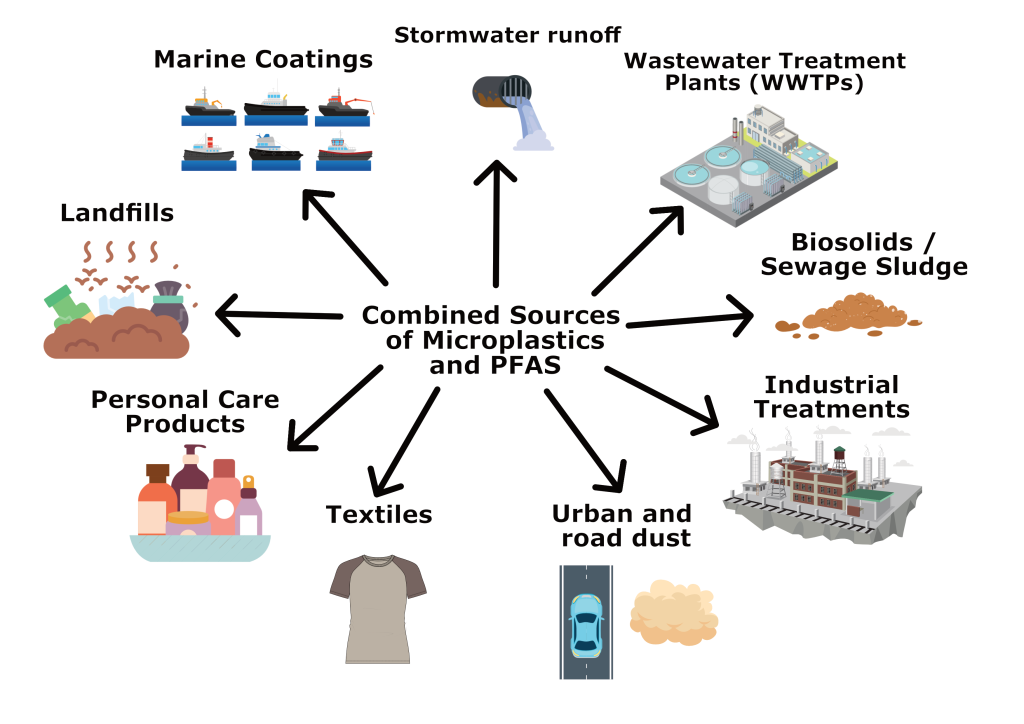
In considering potential environmental impacts, microplastics (MPs) and Per- and Polyfluoroalkyl Substances (PFAS) have a lot in common. They are widely found in the environment, and some can be highly resistant to degradation, persist over long temporal scales, and possess a high transportability.1 In addition, MPs and PFAS can be derived from the same sources such as personal care products, textiles, and coatings2 (Figure 1) and certain PFAS can be used as additives in MPs such as polytetrafluoroethylene (PTFE). These similarities and combined uses can create conditions where they can coexist and subsequently interact with one another.
Interaction mechanisms
The potential for simultaneous exposure to MPs and certain PFAS is an area of increasing study. While the myriad of different types of both MPs (e.g. polyethylene [PE] and polystyrene [PS]) and PFAS (e.g. perfluorooctane sulfonate [PFOS] and perfluorooctanoic acid [PFOA]) make predictions of their combined behaviour challenging, there is evidence that PFAS can adsorb to MPs thus affecting their fate and transport in the environment. Whilst sorption of PFAS onto MPs is governed by complex interactions of physicochemical forces, certain PFAS have been shown to adsorb to certain MPs. The nature of these sorption processes depends on both the individual characteristics of the specific PFAS and MP and the surrounding environmental conditions.3,4 Aquatic environments generally serve as the primary medium for PFAS and MP transport and chemical interactions, and thus consequently represent the ecosystem where the potential for combined interactions is greatest.2
The dominant interaction mechanisms governing PFAS sorption to MPs in aquatic environments may include hydrophobic interactions, electrostatic interactions, and pore-filling mechanisms.1, 2, 3
- Hydrophobic interactions arise where water repels nonpolar molecules (such as certain PFAS and MPs), forcing them together and causing the surrounding water molecules to group together more tightly.
- Electrostatic interactions can cause certain PFAS to bind to MPs due to the attractive or repulsive forces acting between electrically charged particles or molecules.
- Pore-filling mechanisms can cause certain PFAS molecules to occupy micropores and nanopores within MP matrices at the limits of their solubility.
Of these, hydrophobic interactions likely represent the most influential sorption mechanism as most MPs and PFAS are hydrophobic or have hydrophobic portions of their chemical structures. This can cause hydrophobic interactions to become the most dominant force of attraction and ‘overpower’ other MP and PFAS interaction mechanisms.3,5 Other interactive mechanisms that are either included within the three main ones above or play a smaller role include hydrogen bonding, van der Waals forces, and halogen bonding.6
Sorption characteristics of MPs and PFAS
The strength of sorption interactions depends on the characteristics of the specific MPs and PFAS being considered and the surrounding environmental conditions. The main characteristics of MPs that can affect the sorption of substances include size, age, hydrophobicity (the tendency to repel water), and polarizability (how readily molecules can take on an electric charge). Various studies have provided differing results for which polymers have a greater affinity for sorption of certain PFAS, but smaller and older ‘weathered’ MPs have been shown to possess a greater affinity mainly due to their larger surface area to volume ratio, which increases the number of potential ‘sorption sites’ on the MP.6
The main characteristics of PFAS that affect sorption onto MPs include their carbon chain length2,5,6 as well as their hydrophobicity and polarizability).7 Short-chain PFAS are generally more likely to interact with MPs through electrostatic sorption, while long-chain PFAS are more likely to interact via hydrophobic sorption.3,6 With hydrophobicity being the most influential interaction mechanism, long-chain PFAS, such as PFOA and PFOS, have been shown to adsorb to the surface of MPs more readily than short-chain PFAS, such as perfluorobutanoic acid (PFBA) and perfluorobutane sulfonate (PFBS).8
Environmental conditions that affect sorption of PFAS
The intensity of potential interactions between PFAS and MP is heavily modulated by the surrounding environmental conditions. Of these, salinity, pH, and dissolved organic matter (DOM) are believed to be the most influential.1,2 Saline conditions found in seawater and hard freshwater2 can act as a major catalyst by reducing certain PFAS solubility and may cause “squeezing” certain PFAS molecules onto the plastic surface, whilst pH and DOM often act as regulators, limiting interaction between PFAS and MP; higher pH levels increase electrostatic repulsion between PFAS and MP and organic matter can compete for the same limited space on the plastic.
Potential hotspots and sinks
At potential locations where PFAS and MPs may both be found, such as landfills or land receiving regular biosolid applications (Figure 1), PFAS and MPs may be distinctly present or present as colloidal particles (any substance consisting of particles substantially larger than atoms or ordinary molecules but too small to be visible to the unaided eye) within both the solid material and leachate. Where this is the case, MPs may prevent sorbed PFAS from migrating off-site (in particulate form) in soils with less pore space (i.e., more compact); conversely, soils with greater pore space may promote the migration of sorbed PFAS, with MPs more easily able to traverse soil pores.1,2,9 Contaminated land containing both MPs and PFAS on eroding or low-lying coastlines (e.g., coastal landfills) may represent greater potential than inland landfills for combined release of MPs and PFAS, as a result of coastal erosion of soils containing both small and large pores.
Given the high solubility and anionic repulsion of certain PFAS from negatively charged soil particles, they are typically highly mobile in aquatic systems, including groundwater and saturated soils.2 Therefore, you may be asking how MPs can increase the mobility of these already highly mobile PFAS particles in aquatic environments? When sorbed onto MPs, PFAS mobility becomes tied to the fate of the particle until the PFAS is released. If the MP itself is a ‘smaller’ particle (e.g. <100 µm) with a high buoyancy such as low-density polyethylene (LDPE) then it can act as a transport vehicle in this instance, enabling sorbed PFAS to travel longer distances than they would by solute transport alone. This may also be true at slower velocities for smaller MPs with a greater density that can penetrate deeper into groundwater systems and potentially settle on less permeable soils near the bottom of the groundwater system in question.
From a transport and fate perspective, sorbed PFAS are then subject to the suspension ability of the MP, which in turn, can be subject to biofouling, fragmentation, or aggregation and flocculation that can alter the fate of the MP by causing it to sink or float. In summary, MPs containing sorbed PFAS may be transported long distances by currents or settle in sediments within aquatic systems (creating combined MP-PFAS sinks), depending on the MP they are sorbed to and the subsequent environmental conditions to which they are exposed.
Why this research matters
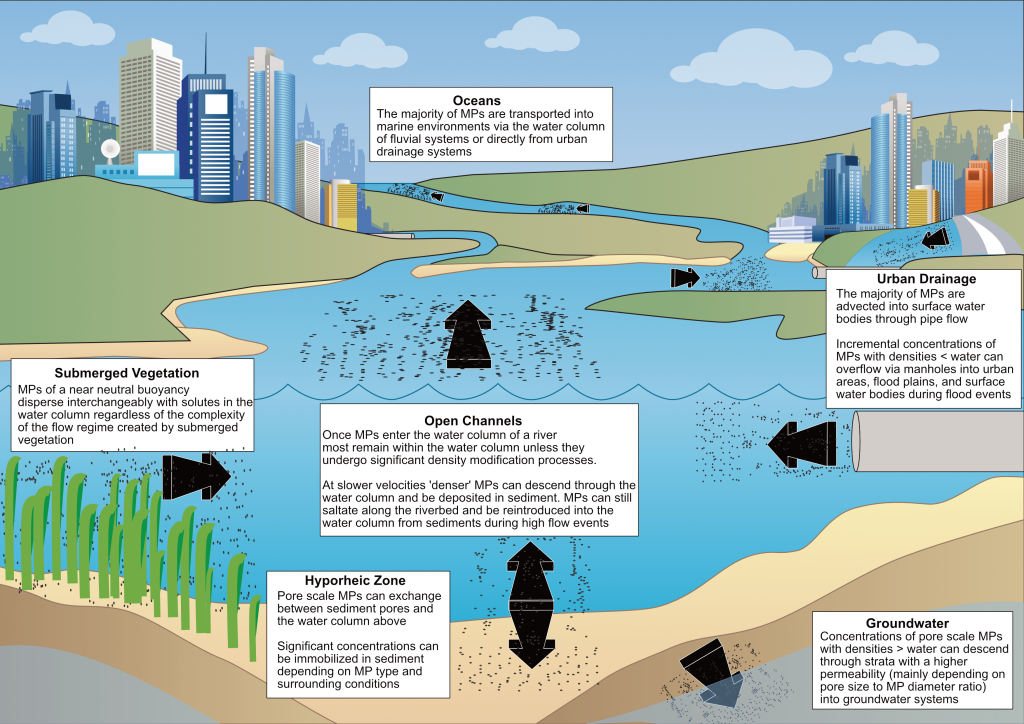
It is apparent that MPs with sorbed contaminants such as PFAS may pose risk assessment and land management challenges. On higher risk sites, where it is likely that high concentrations of smaller MPs (e.g. < 100 µm) are present alongside certain PFAS, potential combined transport and toxicity consequences should be examined and accounted for within management strategies. Aquatic transport and fate characteristics for MPs (e.g. colloidal, sediment, and solute transport modelling where appropriate) may provide insight into potential sinks for MPs with sorbed contaminants such as PFAS.10 Figure 2 summarises some of the major pathways and sinks for MPs.11
It is important to recognise that the ability for MPs to transport sorbed contaminants goes beyond PFAS alone, and industrial facilities that may be releasing MPs in wastewater are likely to come under increasing scrutiny from regulatory authorities in the future regarding their releases. MPs have just been added to both the European Union’s (EUs) quality standards and environmental protection agencies’ (EPAs) ‘watch lists’. More research and monitoring are needed to help identify potential MP combined contamination sources and sinks, and standardise specific management solutions that can be used by industry, landowners, consultants, and regulators to deal with this issue.
Dr Ben Stride is currently a Senior Environmental Consultant with Ramboll. Ben’s work mainly involves emerging contaminants, land contamination, and hydrogeology. He studied the transport and fate of MPs as part of his doctoral research at the University of Warwick. If you have any questions, please contact his email address below.
References
[1] Brenckman, C. M., Borgaonkar, A. D., Pennock, W. H., III, & Meegoda, J. N. (2026). Combined Environmental Impacts and Toxicological Interactions of Per- and Polyfluoroalkyl Substances (PFAS) and Microplastics (MPs). Environments, 13(1), 38. https://doi.org/10.3390/environments13010038
[2] Wang, P., Shi, Y. Z., & Guan, Q. (2025). The Microplastic-PFAS Nexus: From Co-Occurrence to Combined Toxicity in Aquatic Environments. Toxics, 13(12), 1041. https://doi.org/10.3390/toxics13121041
[3] Yu, F., Wu, J., Wang, H., Bao, Y., et al. (2024) Interaction of microplastics with perfluoroalkyl and polyfluoroalkyl substances in water: A review of the fate, mechanisms and toxicity, Science of The Total Environment, 948. https://doi.org/10.1016/j.scitotenv.2024.175000
[4] Prajapati, A., Narayan Vaidya, A. & Kumar, A.R. Microplastic properties and their interaction with hydrophobic organic contaminants: a review. (2022). Environ Science and Pollution Research, 29, 49490–49512. https://doi.org/10.1007/s11356-022-20723-y
[5] Islam, S., Kekre, K, M., Shah, T, A., Tsai, P-C. et al. (2025). Unraveling the complexities of microplastics and PFAS synergy to foster sustainable environmental remediation and ecosystem protection: A critical review with novel insights, Journal of Hazardous Materials Advances, 17. https://doi.org/10.1016/j.hazadv.2025.100621
[6] Mejías, C., Martín, J., Santos, J, L., Aparicio, I. et al. Adsorption of perfluoroalkyl substances on polyamide microplastics: Effect of sorbent and influence of environmental factors, Environmental Research, 216. https://doi.org/10.1016/j.envres.2022.114834.
[7] Leung, S, C, E., Wanninayake, D., Chen, D., Nguyen, N-T et al. (2023). Physicochemical properties and interactions of perfluoroalkyl substances (PFAS) – Challenges and opportunities in sensing and remediation, Science of The Total Environment, 905. https://doi.org/10.1016/j.scitotenv.2023.166764
[8] Parashar, N., Mahanty, B., Hait, S. (2023). Microplastics as carriers of per- and polyfluoroalkyl substances (PFAS) in aquatic environment: interactions and ecotoxicological effects. Water Emerging Contaminants. Nanoplastics, 2, 15. http://dx.doi.org/10.20517/wecn.2023.25
[9] Guo, J-J., Huang, X-P., Xiang, L., Wang, Y-Z. et al. (2020). Source, migration and toxicology of microplastics in soil. Environment International, 137. https://doi.org/10.1016/j.envint.2019.105263
[10] Stride, B., Abolfathi, S., Bending, G. D., Pearson, J. (2025). Hyporheic exchange processes of pore-scale microplastics. Science of the Total Environment, 982. https://doi.org/10.1016/j.scitotenv.2025.179573
[11] Stride, B. (2024). Doctoral thesis on ‘Quantifying microplastic transport in freshwater and wastewater flow domains’. University of Warwick. http://webcat.warwick.ac.uk/record=b4091156
Header image: © wonderisland | Adobe Stock
