

The FWR is part of the Institution of Environmental Sciences family – a professional body uniting science and people to accelerate the transition to a thriving environment. Covering 20 specialisms, the IES is at the forefront of uniting the environmental sciences around a shared goal: to work with speed, vision and expertise to solve the world’s most pressing environmental challenges, together. Find out more.
New-build water supplies and regulation changes
Competition for household retail in the water industry was introduced in 2017. This allowed the provision of drinking water supplies to new housing developments by newly Ofwat-appointed and licensed inset water companies, in areas that would have previously been billed and supplied by the local incumbent water company. Since that time, the New Appointments and Variations (NAV) insets market, where these newly appointed inset companies compete with existing water companies to supply new housing developments, has grown significantly. Now, over 545,000 consumers are supplied by a group of twelve licensed NAV inset appointees focused on the provision of supplies, via what is most commonly the last mile of distribution networks on new housing developments. They operate and maintain a supply of water from the local incumbent water companies’ supply system. In the last three years, several newly licensed inset water companies have entered the market, expanding the provision of supplies to new-build developments across England and Wales.
The development of this new household retail market has seen a new water quality data set emerge. The Water Supply (Water Quality) Regulations 2016 (as amended) require each housing development supplied by a NAV to typically be designated as its own water supply zone, unless the NAV has an existing site in the area supplied by the same source water.1 As a result, the regulations require that each housing development must be sampled at a regular frequency, as part of the regulatory drinking water compliance sampling programme.
These sampling requirements differ from the scenario of a traditional incumbent water supplier providing supplies to a new housing development. In these circumstances, the new housing development is typically consumed within an existing water quality zone, and the requirement to sample the new properties is significantly reduced, due to the regulatory requirement for the random selection of sampling locations across the water supply zone. As incumbent water supply zones are often large – up to a maximum population of 100,000 – the certainty that the new development will be sampled for compliance purposes is therefore significantly diminished. This explains why, prior to 2017, the number of new housing developments sampled regularly will have been far less than the number sampled since competition was introduced.

Nickel and lead in new housing developments
The data generated by the NAV inset appointees in carrying out their duties has grown recently, with 88,997 compliance samples taken from NAVs in 20252 compared to just 10,449 in 2020.3 One interesting trend to emerge from the larger dataset is an increase in the number of samples failing the regulatory standards for lead and nickel in samples taken at consumers’ taps in new housing developments. For lead, five samples failed the 10 µg/L regulatory standard in England, accounting for 8.3% of all lead failures nationally. For nickel, there were 14 failures of the 20 µg/L regulatory standard in samples taken from new housing developments, accounting for 19.4% of the failures in England.2
New housing developments will typically consist of a drinking water distribution network made of polyethylene pipes. Internally, new domestic properties will utilise copper or polyethylene pipe with a range of plastic and metallic fittings, all of which are typically certified for use in the provision of drinking water. Lead solder used in drinking water systems was banned in the UK in 1987, with the use of lead supply pipes phased out in the 1970s.
Where are the metal contaminants coming from?
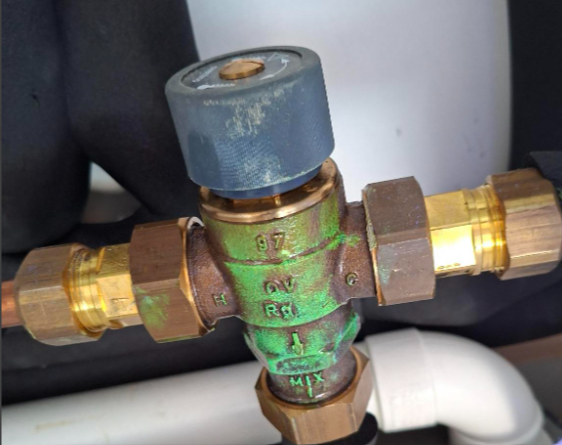
For lead, the answer appears to be either the rare and illegal use of lead solder, or the leaching of metals from the various metallic water fittings and/or inline point-of-use treatment devices. These products are installed by the housing developers within the domestic plumbing system. Figure 1 shows the results of a lead fluorescence test, highlighting the presence of lead in a brass thermostatic mixer valve found at a new school on a new housing development.
For nickel, the most common source of the contaminant is leaching or flaking from plated kitchen taps and fittings. It is well-recognised that the best control measures for nickel leached from taps and fittings are to flush the tap before drinking, particularly after periods of stagnation, and to only use products with specifications delivered through an appropriate certification scheme for materials in contact with drinking water.4 However, the water industry is still seeing regular failures above the prescribed concentration, with one fifth of breaches in England in 2025 determined to be due to leaching of nickel from new taps or fittings.
The Water Supply (Water Fittings) Regulations, 1999 give water companies and New Inset Appointees a range of powers to ensure the conformity of any water fitting regarding the Regulators’ Specification for fittings.5 The Regulators’ Specification defined in the Byelaws requires the following:
Byelaw 7 (1)
No material or substance which causes, or is likely to cause, contamination of water shall be used in the construction or installation of any pipe or water fitting which conveys or receives water supplied for domestic purposes.
Byelaw 51
No water fitting which conveys water supplied by the undertakers for domestic purposes shall – (a) be made wholly or partially of, or incorporate, or (b) be lined or coated with, any material or substance which contaminates, or is likely to contaminate, such water by altering its colour, odour, taste or composition.
To comply with these Byelaws, the fittings must meet the requirements of IGN 9-01-02 Issue 2: Requirements for the testing of non-metallic products for use in contact with potable water6 or BS 6920: Part 2: Suitability of non-metallic products for use in contact with water intended for human consumption with regard to the effect on the quality of the water.7
Most developers will typically install water fittings from one of the approved lists of products certified by bodies such as The Water Regulations Approval Scheme (WRAS) or Kiwa UK. Whilst these products will have passed the BS 6290: Part 2 conformity test, these tests only assess the propensity of non-metallic products to impact water quality. Therefore, with no certified assessment of whether significant amounts of metals such as lead or nickel can leach from the metallic fittings, there remains the risk that an approved fitting may adversely impact water quality by leaching metals.
Research has shown that the highest concentration of lead leaches from new fittings immediately after installation, and that the concentration reduces with length of time in service, stabilising over a period of a few weeks to a few months.8 It therefore makes sense that due to new housing developments comprising all new fittings, they are a high risk for leaching metals in the first few months of occupation. This risk might be further increased due to the phased way in which housing developers often connect properties to the drinking water network. Show homes are at a heightened risk of metals being present at the consumers’ tap. Often, they have their water supply connected early in the development and are subject to long periods of low or no turnover of the distribution network and internal plumbing system. These periods of stagnation increase the risk of leaching of metals from internal pipework, fittings and taps, meaning any samples taken during this period have a high probability of exceeding the prescribed concentrations.
Solutions and treatment options
Phosphate dosing has been shown to have a rapid effect on the leaching of lead from fittings, reducing both the time taken to reach a stable leaching concentration and reducing the concentration compared with non-phosphate dosed water. The decision to dose orthophosphoric acid (phosphate) for plumbosolvency (lead) control can therefore have a significant impact on the leaching of metals from new fittings. Each water company will have their own criteria and modelling for deciding whether plumbosolvency control is needed in a supply area. Typically, the criteria for assessment will include the hardness, alkalinity, and other dissolved anions concentrations in the water supplying the area, and whether there are large numbers of properties connected to the network by lead communication and supply pipes. Areas with moderately hard water and a low density of lead supply pipes may be considered a low risk and may not require plumbosolvency control. Unfortunately, this assessment is unlikely to consider the number of new housing developments in an area and the propensity of their new fittings to leach lead. Therefore, it seems that new housing developments may yet again be at higher risk of elevated concentrations of lead where certain metallic fittings are used.
The water industry is aware of the risks to water supplies introduced via certain plumbing fittings, and in the case of lead, water companies and regulators are working closely together too, as part of a Water UK-coordinated group to promote best practice across the industry. One of the focus areas is the removal of new sources of lead in drinking water. However, the water industry cannot mitigate the risk of nickel and lead in new properties alone. There must be action by the housing industry and their regulatory bodies to ensure plumbing systems in new buildings pose as low a risk as possible to those who will eventually inhabit them.
References
[1] The Water Supply (Water Quality) Regulations 2016. (2016). The Water Supply (Water Quality) Regulations 2016. https://www.legislation.gov.uk/uksi/2016/614/contents
[2] Drinking Water Inspectorate (DWI). (2026). Drinking Water 2025: Summary of the Chief Inspector’s report for drinking water in England. https://www.dwi.gov.uk/what-we-do/annual-report/drinking-water-2025/drinking-water-2025-summary-of-the-chief-inspectors-report-for-drinking-water-in-england/
[3] Drinking Water Inspectorate (DWI). (2021). Drinking Water 2020: Summary of the Chief Inspector’s report for drinking water in England. https://www.dwi.gov.uk/what-we-do/annual-report/drinking-water-2020/
[4] World Health Organization (WHO). (2021). Nickel in drinking-water: Background document for development of WHO Guidelines for drinking-water quality. WHO/HEP/ECH/WSH/2021.6. https://www.who.int/publications/i/item/WHO-HEP-ECH-WSH-2021.6
[5] The Water Supply (Water Fittings) Regulations 1999. (1999). The Water Supply (Water Fittings) Regulations 1999. https://www.legislation.gov.uk/uksi/1999/1148/contents/made
[6] Water Regulations Advisory Scheme (WRAS). (n.d.). IGN 9-01-02, Issue 2: Requirements for the testing of non-metallic products for use in contact with potable water
[7] British Standards Institution (BSI). (n.d.). BS 6920: Suitability of non-metallic products for use in contact with water intended for human consumption with regard to the effect on the quality of the water. https://doi.org/10.3403/BS6920
[8] UK Water Industry Research Limited (UKWIR). (2014). Brass fittings – A source of lead in drinking water? REF NO 14/DW/04/14. https://ukwir.org/eng/reports/14-DW-04-14/66735/Brass-Fittings–A-Source-of-Lead-in-Drinking-Water
Further reading
WRc Evaluation & Testing Centre Ltd. (1998). Test Code Sheet Number 21111 – WBS Test & Acceptance Criteria. https://www.waterregsuk.co.uk/downloads/regulations/fittings/2111.1.pdf
Header image © Jevanto Protography via Adobe Stock
